Newborn Sensory Development Toys: A 2026 Guide
Table of Contents
- How Newborn Senses Develop in the First Weeks
- Developmental Milestones 0-3 Months: What to Expect
- Types of Newborn Sensory Toys and What They Do
- Why High Contrast Baby Toys Matter in Early Development
- Sensory Play Ideas for Newborns You Can Try at Home
- Safety Considerations When Choosing Newborn Sensory Toys
- Conclusion
- Frequently Asked Questions
Last Updated: September 23, 2026
How Newborn Senses Develop in the First Weeks
A newborn's senses arrive largely ready to work, but they sharpen dramatically in the first twelve weeks. Newborn sensory development toys work because they match what a baby can actually perceive: strong contrast, gentle sound, and soft texture.
Babies are not blank slates. They can see, hear, and feel from day one, but each sense is calibrated differently, and understanding those differences changes how you choose what to place in their hands.
Sight, Sound and Touch: What Changes and When
Sight is the slowest sense to mature. A newborn sees clearly at roughly 20 to 30 centimetres, about the distance from your face to theirs during a feed. Beyond that, the world is a blur.
Hearing is more developed at birth. Babies recognise their mother's voice and turn towards familiar sounds within days.
Touch is the most mature sense of all. The NHS guidance on bonding and infant development notes that skin-to-skin contact helps regulate a baby's temperature, breathing, and heart rate in the early weeks.
Developmental Milestones 0-3 Months: What to Expect
The 0-3 month window is when babies move from reflex to intention. Tracking, head turning, and the first social smiles all appear here.
Parents often worry their baby is behind. In practice, the range is wide. Some babies track a moving object at four weeks; others take until ten. Both are normal.
What matters is progression, not speed. A baby who gradually follows faces, responds to sound, and grips a finger is doing exactly what they should.
Age |
What Typically Develops |
How a Sensory Toy Helps |
|---|---|---|
0-4 weeks |
Focuses at 20-30cm, startles at sound |
High contrast shapes held close |
4-8 weeks |
Begins tracking movement, calmer with touch |
Soft textured objects, gentle rattles |
8-12 weeks |
Reaches and bats at objects, social smiling |
Lightweight toys within batting range |
That table is a guide, not a test. If a baby seems unresponsive to sound or light, speak to a health visitor rather than relying on a chart.
Types of Newborn Sensory Toys and What They Do
Sensory toys for newborns fall into a few broad categories, and each one targets a different sense. Choosing well means matching the toy to the sense that is ready for stimulation.
High contrast cards and soft books train visual tracking. Gentle rattles and soft chimes build sound localisation. Textured objects, from ribbed fabrics to natural rubber, develop grip and mouth awareness.

Signature Fox Teether
The best first toys are simple. A single strong feature beats five competing ones, because a newborn cannot process a busy object.
Teethers, Plush Companions and Textured Comfort Objects
Teethers and plush companions do more than soothe. They introduce different weights, temperatures, and surfaces to small hands.
Natural rubber is a common choice because it warms to the skin and offers a firm-but-giving resistance. Plush companions bring softness and a familiar scent, which can comfort a baby during settling.
What most guides miss is that texture variety matters more than quantity. One toy with three distinct surfaces teaches more than three toys with identical ones.
Why High Contrast Baby Toys Matter in Early Development
High contrast baby toys matter because a newborn's colour vision is still forming. Black, white, and bold red register far more strongly than pastels in the first weeks.
This is not a marketing claim. It follows directly from how the eye develops: the cells that detect contrast mature before those that detect fine colour. A bold pattern gives the visual system something it can genuinely grip.
Sensory Play Ideas for Newborns You Can Try at Home
Sensory play ideas for newborns do not require a cupboard full of equipment. Most of the best ones use your face, your voice, and one simple object.
How to Pick Durable Baby Blankets: 2026 Parent Guide
Try these at home:
- Slow tracking: Move a high contrast card across your baby's line of sight, pausing at each end.
- Sound mapping: Shake a soft rattle to one side, wait for the head turn, then switch sides.
- Texture exploration: Guide a textured toy lightly across the palms and the soles of the feet.
- Voice play: Narrate what you are doing in a warm, unhurried tone. Familiar voices are the original sensory toy.
- Tummy time with contrast: Place a bold pattern on the floor during supervised tummy time to give them something to lift toward.
Keep sessions short. Two to three minutes is plenty in the early weeks, and stopping before a baby becomes fractious keeps the experience positive.
Safety Considerations When Choosing Newborn Sensory Toys
Safety comes down to a few checks that take seconds but matter enormously. Every toy that reaches a newborn should pass all of them.
- No small parts. Anything that could detach and fit through a small-parts gauge is a choking risk.
- No long cords or strings. These present a strangulation hazard in a cot or pram.
- Washable materials. Newborns mouth everything, so check the care instructions before buying.
- Non-toxic finishes. Look for toys made from materials that are safe to mouth, with no flaking paint.
- Sealed construction. A single sealed piece cannot trap moisture or harbour bacteria the way a seamed one can.
- Age labelling. A toy marked 0+ months has been assessed for the youngest users.
A well-made teether or clip should also be easy to clean and quick to dry, because it will be washed often.
Conclusion
Choosing well for a newborn is less about buying more and more about matching the toy to the sense that is ready. When a piece is thoughtfully made, it does the developmental work quietly, in the ordinary moments of the day.
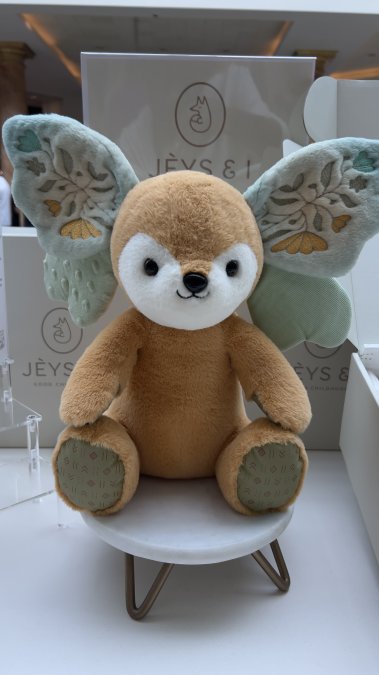
That is where JÈYS & I comes in. Our Signature Fox Teether is handcrafted from 100% natural rubber as a single sealed piece, with multiple textures for sensory exploration and safe mouthing from birth. Our Badia Fox Plush Companion brings softness, mixed tactile fabrics, and signature detailing for comfort and discovery, while the Teething Essentials Duo pairs the teether with a plant-based dummy clip to keep it clean and close. Each arrives in gift-ready packaging, made for the first weeks and the months that follow.


Frequently Asked Questions
What are the best sensory toys for a newborn?
The best newborn sensory toys are simple, safe and suited to early development. Look for soft textured objects babies can grasp, such as natural rubber teethers or small plush companions with different fabric surfaces. High contrast baby toys in black, white and red help stimulate visual tracking in the first weeks. Choose items that are lightweight, easy to clean and free from small detachable parts. A single well-made textured toy often works better than a basket full of options, because newborns can only process one or two sensations at a time.
How do sensory toys help with baby development?
Sensory toys give babies repeated, gentle chances to practise looking, listening and feeling. Each interaction builds neural pathways linked to focus, motor control and emotional regulation. For example, following a high contrast shape with their eyes strengthens visual tracking, while gripping a textured teether develops hand strength and mouth awareness. Research in early child development consistently shows that responsive, sensory-rich environments support cognitive and social growth. The key is matching the toy to your baby's current stage rather than rushing ahead.
At what age should a baby start using sensory toys?
You can introduce sensory toys from birth. In the first weeks, newborns respond best to high contrast patterns, soft sounds and gentle textures against their skin. By six to eight weeks, they begin to swipe at objects and track movement more deliberately. Between two and three months, textured teethers and plush companions become more useful as hand control improves. Always supervise and follow the age guidance on each product. A toy suitable from birth, such as a natural rubber teether, is a safe starting point.
Are high contrast toys beneficial for newborns?
Yes. Newborns see best at close range and respond strongly to bold contrasts because their colour vision is still developing. High contrast baby toys using black, white and red patterns give them something clear to focus on, which supports visual tracking and attention. You can use them during tummy time or hold them about 20 to 30 centimetres from your baby's face. Short sessions of a few minutes are enough. As your baby's sight matures around three months, gradually introduce more colours and softer contrasts.
Start with one or two pieces that suit your baby's stage, and build from there as their senses sharpen. Explore the JÈYS & I collection to find thoughtfully made newborn sensory development toys designed to grow alongside your child.